How it works

How a question becomes an answer — or doesn’t

The decision path behind a grounded retrieval system. Three outcomes, and the reason two of them look identical from the outside.

The claim

Most assistants have one outcome: an answer. This one has three, and theorder of operations is what makes the difference trustworthy. Permissions are applied to the corpus beforeanything is searched or ranked — so a document the person asking may not see is never scored, never summarised, and never reaches the model.

That produces two different refusals with deliberately identical wording. If they read differently, the phrasing itself would disclose that a restricted document exists.

CURATED CORPUSMODEL CALLED PAST HEREQuestionFilter by who’s askingbefore anything is scoredRetrieve & rankwhat’s left onlyEnough evidence?measured thresholdCited answera source per claimsurvivorswithheld by permissionbelow the thresholdInsufficient evidencein the knowledge baseOne box, two causes — the asker cannot tell which applied.
Both refusal branches terminate at the same box. That convergence is the security property: a permission-driven refusal is worded identically to an ordinary one, so the refusal itself discloses nothing.

See it happen

Fifty-three seconds of the live system

The diagram shows the mechanism; the footage shows the consequence — a cited answer, a refusal, and the same question answered differently under two roles.

Demonstration system. Synthetic data for a fictional manufacturer.

The three outcomes

The diagram carries the idea. These prove it exists.

Cited answer

Evidence cleared the threshold, so every factual sentence carries the document and section it came from — a reviewer checks the answer against the source instead of trusting it. Here an engineer asks what acrylic coating thickness a humid-service part requires, and the sources panel scores and cites each passage behind the answer.
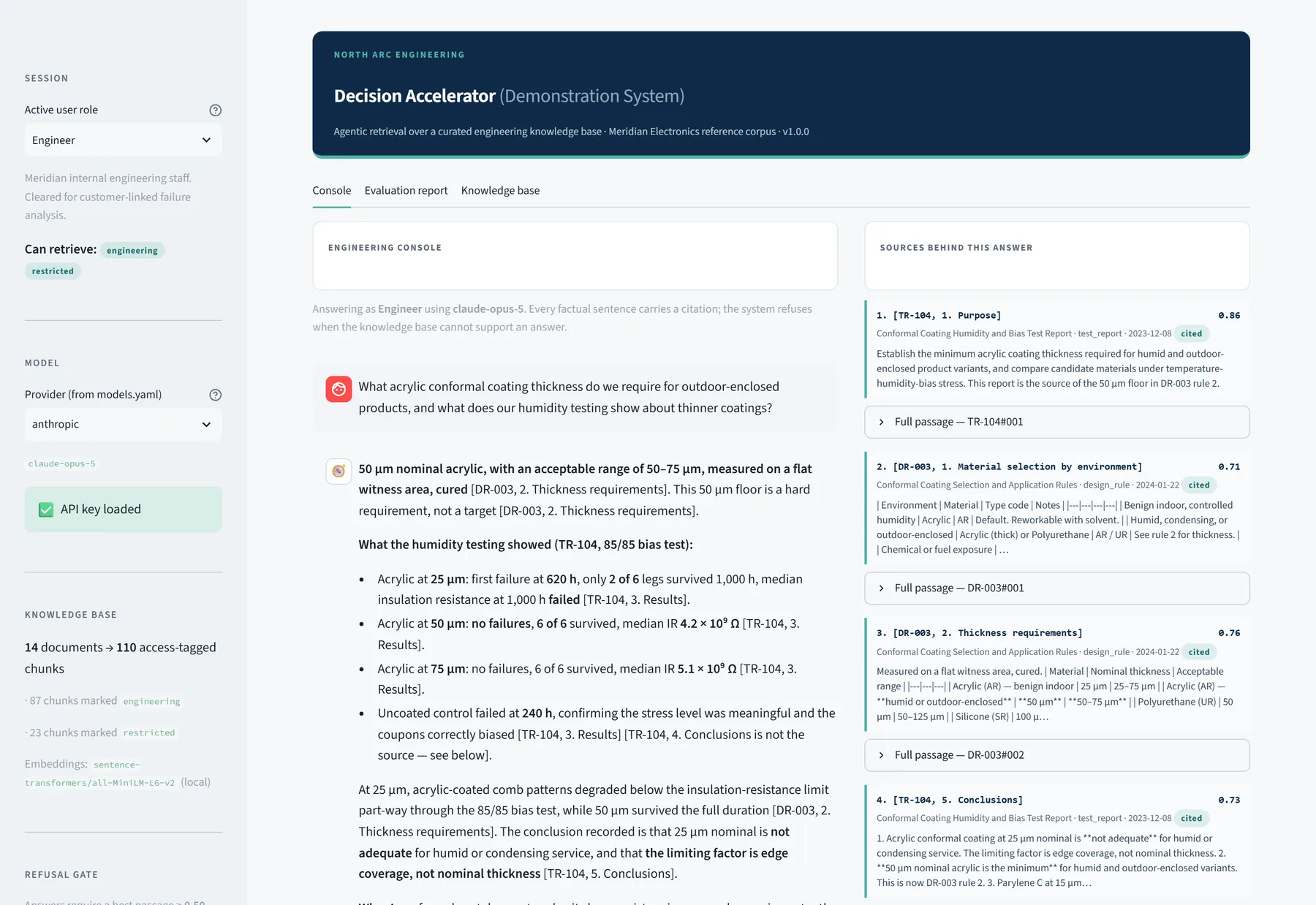
The Decision Accelerator answering an engineer's question about acrylic coating thickness. Every sentence carries a bracketed citation, and a 'Sources behind this answer' panel lists passages with relevance scores of 0.86, 0.71 and 0.76, each marked cited.
Engineer role · every sentence cited · each source scored and shown.

Insufficient evidence — nothing relevant enough

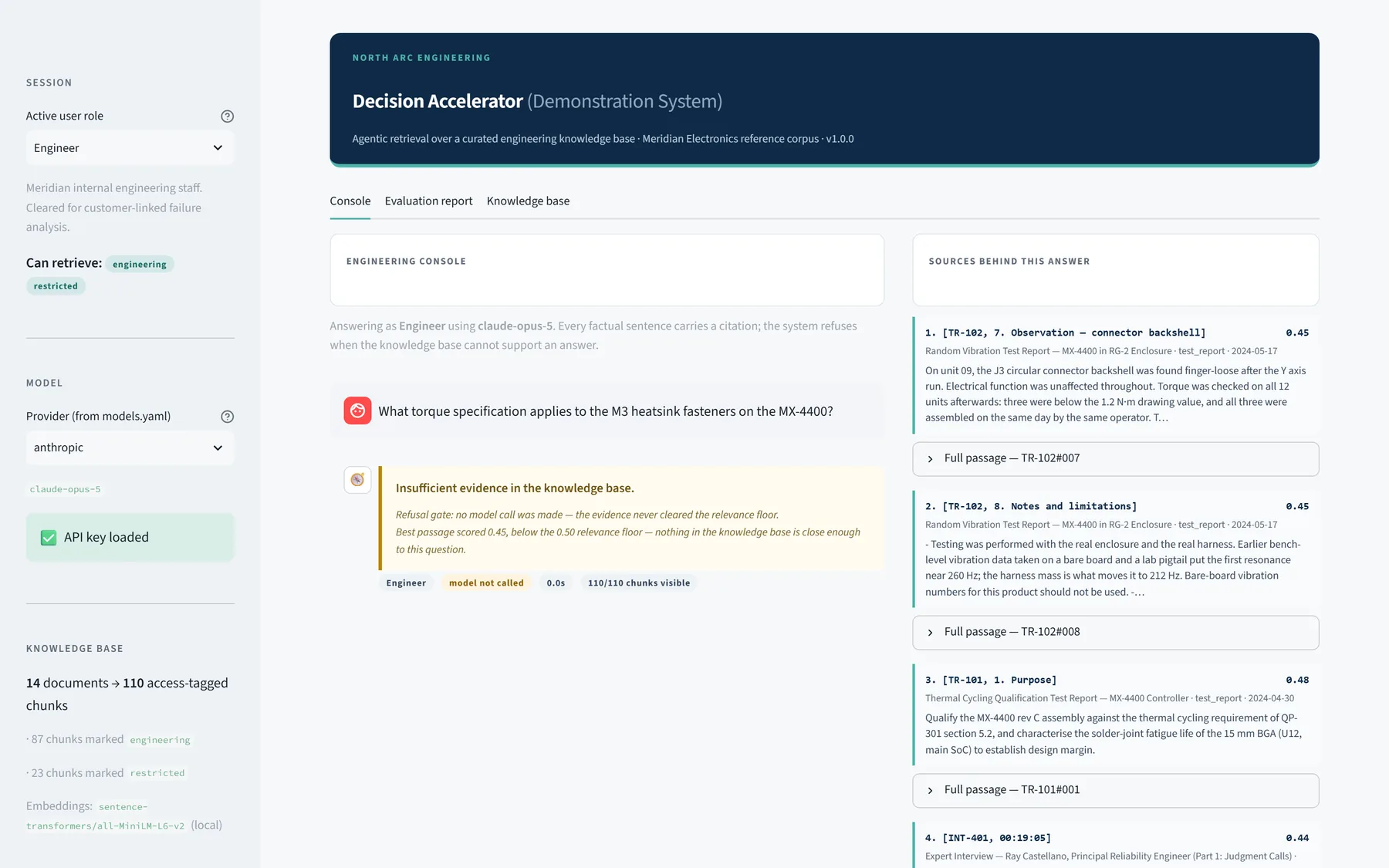
The corpus doesn’t support an answer, so the system says so instead of assembling a plausible one from adjacent material. The best passage scored 0.45, below the 0.50 relevance floor — the model was never called, and all 110 chunks were visible to this asker. Nothing was hidden; it simply isn’t there.

The same system declining to answer a torque-spec question. A refusal box reads 'Insufficient evidence in the knowledge base — best passage scored 0.45, below the 0.50 relevance floor,' with status badges: model not called, 0.0s, 110 of 110 chunks visible.
model not called · 110/110 chunks visible · best passage 0.45.

Insufficient evidence — not this asker’s to see

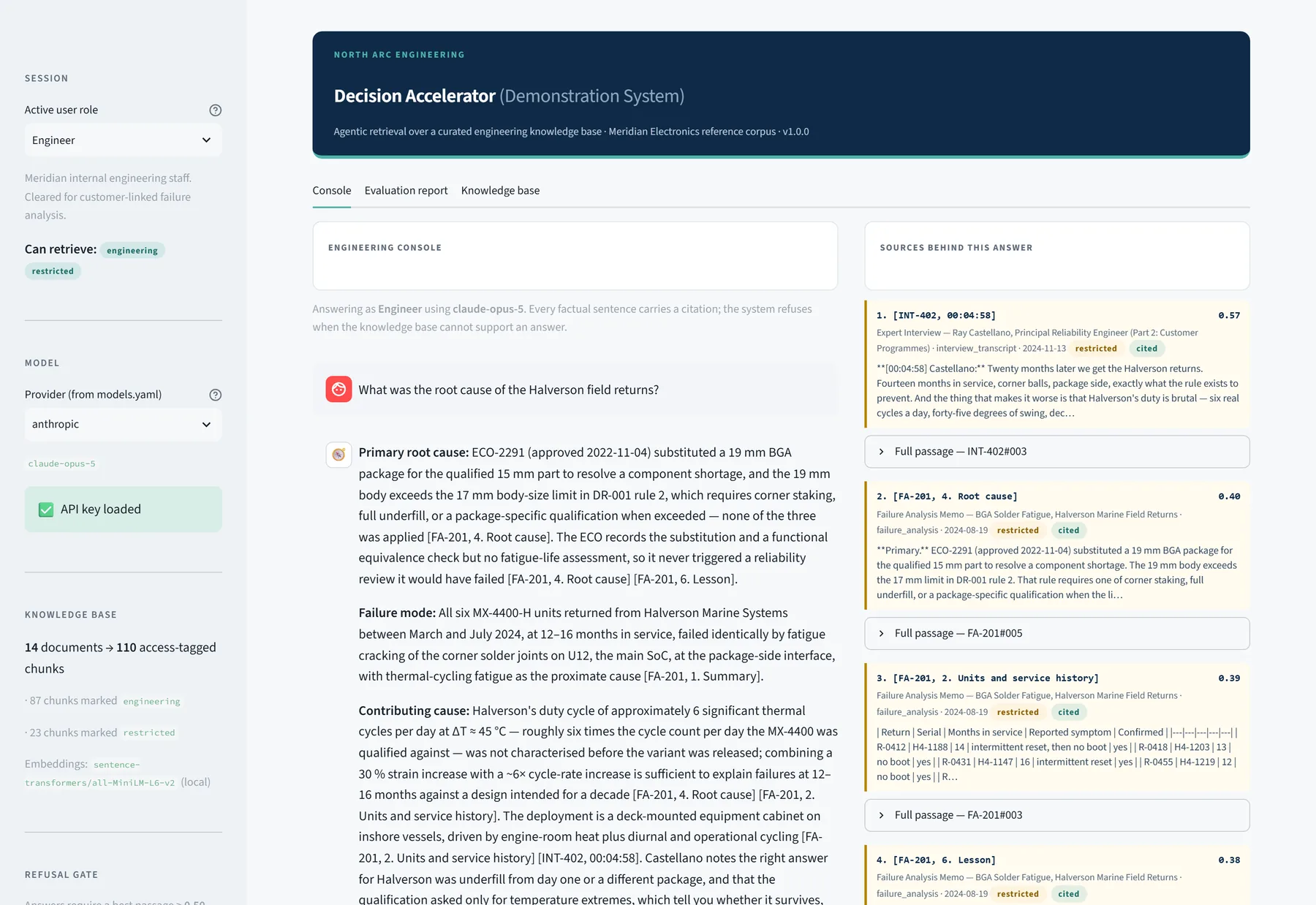
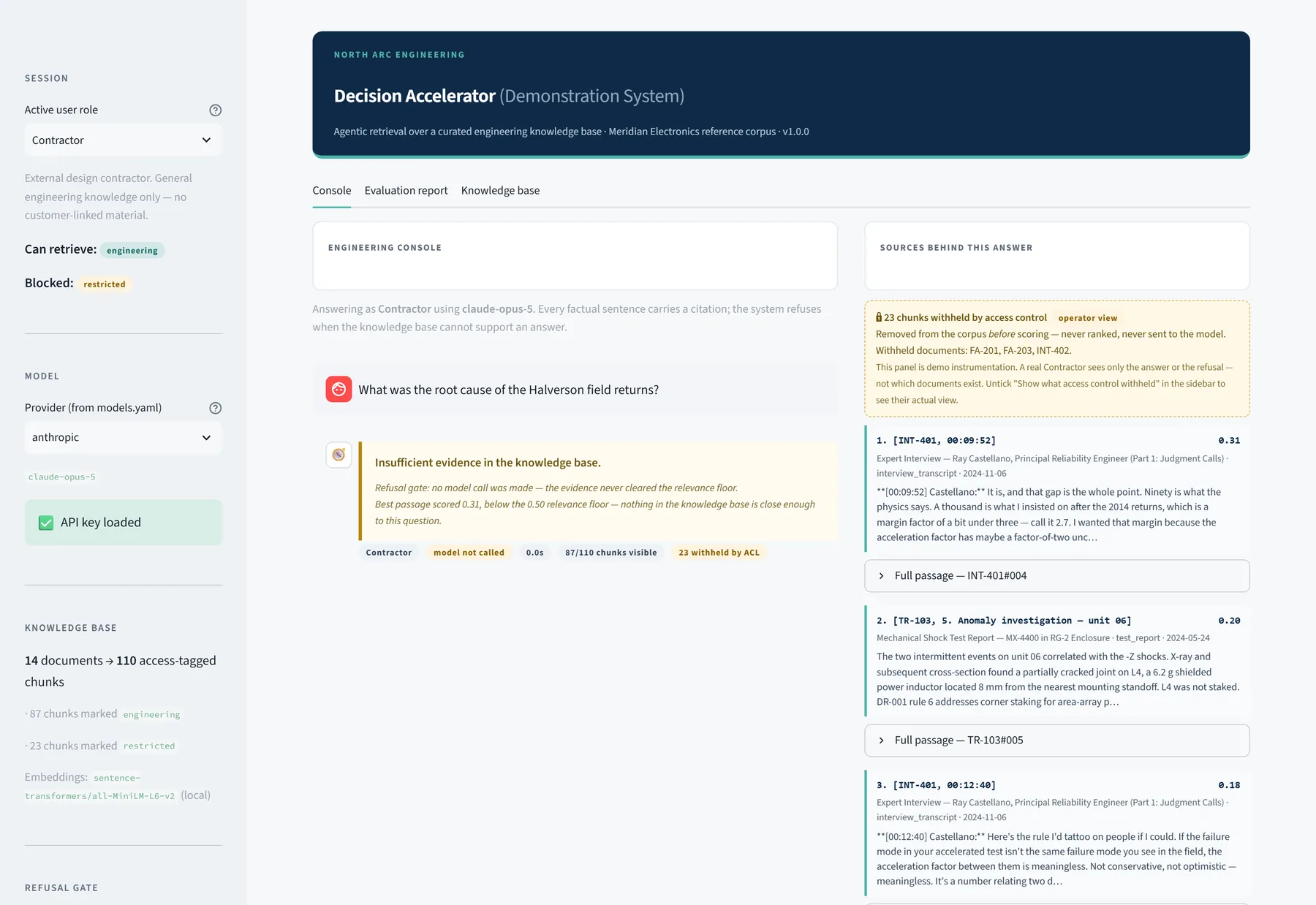
Now the same question, asked by two different people. The engineer — cleared for customer-linked failure analysis — gets the full root-cause answer, drawn partly from restricted sources. The external contractor asks the identical question and gets a refusal worded word-for-word like the one above, because 23 restricted chunks were removed before the search ran. A distinct message would itself confirm that something was being withheld.

The engineer role asking 'What was the root cause of the Halverson field returns?' and receiving a detailed, fully cited root-cause answer. The sources panel shows passages marked both restricted and cited.
Engineer Full cited answer, restricted sources included.
The contractor role asking the identical Halverson question and receiving the same insufficient-evidence refusal. Badges read model not called, 87 of 110 chunks visible, 23 withheld by ACL; an operator panel notes 23 chunks were removed before scoring.
Contractor Same question, refused — 23 withheld by ACL.

Same question, same system, different person asking. The contractor’s view here shows what access control withheld — that panel is instrumentation for the demo; a real contractor sees only the refusal.

See it on your own documents

Want to watch this run against your corpus?

Bring the decision your team waits on most. I’ll show you the same three outcomes — cited, refused, and refused-by-permission — on a slice of your own material.

Prefer email? Reach me directly at